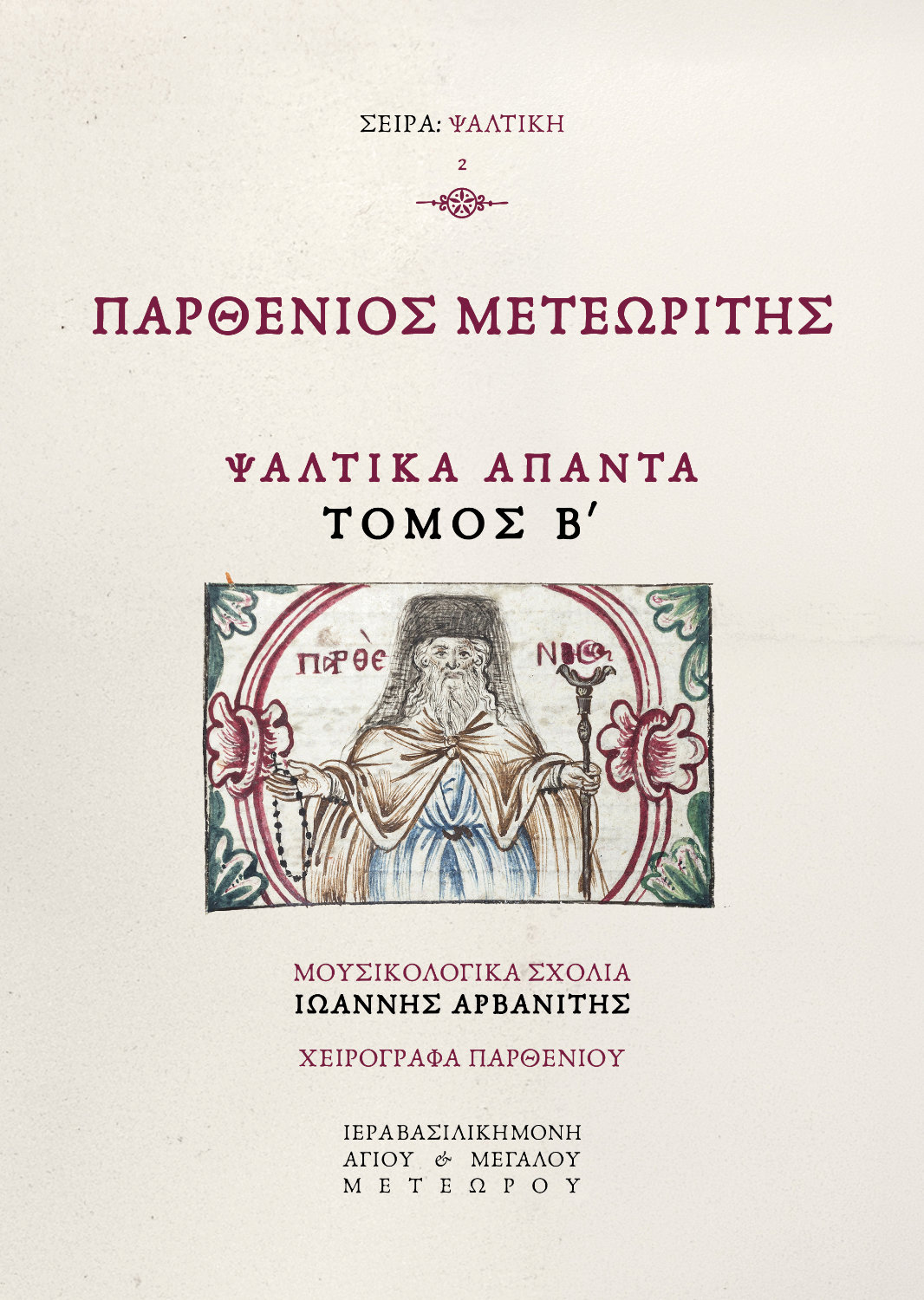
Parthenios of Meteora COMPLETE Works, Volume II

Musicological commentary by Ioannis Arvanitis.
Manuscripts of Parthenios in Old Byzantine Notation.

  • 1st Edition, Full Color
  • Hardcover, p. 300
  • Composer: Parthenios of Meteora
  • Musicological commentary: Dr. Ioannis Arvanitis

PREFACE

      My involvement with the Complete Works of Parthenios of Meteora began in 2015, when my friend and student Yorgos Bilalis, in the context of searching for some manuscripts for his scientific work on the musical composition Ὁ χορτάσας λαὸν ἐν τῇ ἐρήμῳ (He who fulfilled the people in the desert), visited the Monasteries of Meteora and asked me what else of musical interest he could find there. I mentioned to him the musical work of Parthenios of Meteora contained in the manuscripts of the Holy Monastery of Transfiguration, also known as the Great Meteoron (IMMM). I first became acquainted with Parthenios’ work in 1993 at the musicological study of the Foundation for Byzantine Musicology “Parthenios the Hieromonk of Meteora (fourth quarter of the 18th century); his life and work” with the speaker Professor Gregory Stathis, which took place within the framework of the Hellenic-Danish Symposium on Philosophy and Byzantine Music. In that musicological study, a few compositions by Parthenios were presented, transcribed in the New Method notation (NM) by Professor Greg. Stathis.
      Since Parthenios’ work remained essentially untranscribed and unknown, we agreed with the Holy Abbot of the Holy Monastery of the Transfiguration, Archmandrite Nephon Kapsalis, to provide the musicological community and the cantors the Complete Psaltic Works of Parthenios transcribed by me in the NM (Volume A), accompanied by musicological analysis – comments on my transcriptions, together with the original manuscripts Met 329 & 340 (Volume B).
      Thus, I began the study and transcription of the musical works of Parthenios, based initially on the manuscripts Met 329 and 340 that were photographed by Y. Bilalis. Later, I discovered that some compositions of Parthenios were also found in manuscripts of the Monastery of Xenophon (Mt. Athos) and the Monastery of Vatopedi (Mt. Athos), which were also photographed by Y. Bilalis. I also needed several manuscripts from the National Library of Greece (EBE) which were also photographed by Bilalis or studied there by myself.
      I interpreted and transcribed the Complete Works of Parthenios during the years 2015-2016. With the help of God, they are now published. In the first volume, my transcriptions in the NM are presented. For easier chanting use, the publishing order of the compositions is the one in which they are chanted in the Liturgical Services of the Church, with the compositions of the Presanctified Liturgy, the Akathist Hymn and the Kalophonic Heirmos to be the last ones, and not in the order that are found in the manuscript Met 329.
      The second volume presents the original compositions from the manuscript Met 329, the main source of Parthenios’ work, as well as from other manuscripts that contain fewer or isolated compositions of his. Also, a more extensive and detailed description of Parthenios’ compositions is given, his position and characterization as a composer, the peculiarities of his musical notation, references to earlier transcriptions of his compositions, as well as what I needed to study for the transcriptions I attempted. After some general and brief remarks on transcriptional methodology, which arise from my general research and involvement with the old notation and its exegesis, detailed comments on the morphology as well as on the transcription are given per each composition (as far as I see necessary to include), but also on the necessary corrections of some errors in the original musical texts. The compositions are commented in the order in which they are presented in the first volume.
      The Complete Works of Parthenios also include the musical recordings of all the transcriptions of Parthenios’ compositions, the fruit of the labour and artistic effort of the professional Ensemble Romeiko, under the guidance of our dear friend Y. Bilalis.
      Presenting this publication, I first of all thank Gift-Giver God and the Lady Theotokos who have merited me to carry out and bring to completion this work. I thank the Venerable Abbot of IMMM, Fr. Nephon Kapsalis, for accepting the proposal, undertaking the publication and all the support for its realization. I thank my dear friend, student and collaborator Yorgos Bilalis for his ideas and motivation to undertake this work, his effort in taking photographs of all the manuscripts, but also his general direction in the perfect presentation of this publication. I also thank him for undertaking and carrying out the exceptional musical performances with his choral Ensemble Romeiko, as well as all the members of the Ensemble and the friends who contributed exceptionally with their voices.
      I thank the Abbot of the Holy Great Monastery of Vatopedi, Fr. Ephraim, as well as the fathers of the Monastery, especially the librarian Fr. Philippos, for photographing and granting permission for publication of photographs of Parthenios compositions from the manuscripts of the Monastery. I also thank the Abbot of the Holy Monastery of Xenophon Fr. Alexios for granting permission for the Pasapnoaria of Parthenios’ manuscripts to be photographed and published from the Monastery’s manuscripts. I also thank the National Library of Greece and its beloved Director the late Philippos Tsimpoglou for allowing the publication of photographs with Parthenios’ compositions, as well as the staff of the Manuscripts Department of NLG for their love and cooperation during the four years I worked there, where I also had the opportunity to research many things related to the compositions of Parthenios and their interpretation.
      I would also like to thank the “Master of typographic art”, dear Mr. Ioannis Soukis, who not only created, after our encouragement and provision of manuscripts, the musical font “Chourmouzios”, electronically reproducing the handwriting of the eminent transcriber of the NM Chourmouzios the Archvist (†1840), and with this font he undertook the typing of my handwritten transcriptions into the NM, but also edited with art and passion the typographic arrangement of all parts of this volume.

Ioannis Arvanitis, B.Sc., Ph.D.
Associate Professor of Music of the Eastern Orthodox Church
Ionian University, Greece